 346 262 6075
 info@firedos.com


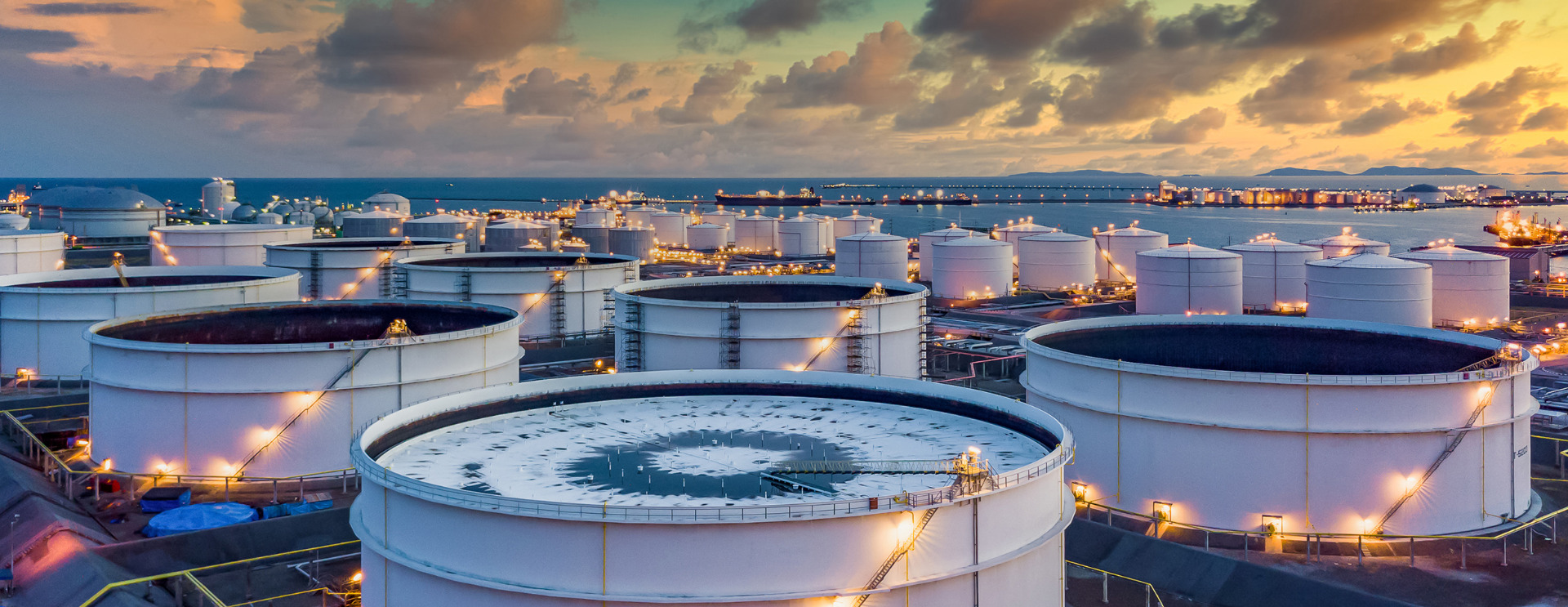
Combining stationary and mobile firefighting systems is advantageous.
Reducing risks through versatile fire protection systems
Oil & gas industry: Tank farms
Extinguishing tank farm fires is one of the most challenging scenarios for which firefighters and emergency services must prepare. The number and size of tank farms worldwide is ever-increasing, so risk mitigation and asset protection must be adaptable. Stationary extinguishing systems in tank farms are supplemented by mobile extinguishing technology to provide additional safety and flexibility.
Fire protection products for the oil and gas industry are classified as fire Class B. This means they require special extinguishing systems, i.e., foam extinguishing systems, as foam is considered the best extinguishing agent for liquid fires. Water is also used as an extinguishing agent for tank wall cooling and gas mitigation applications.

Assets to be protected:
- Flammable liquids/substances such as crude oil and polar solvents, which are soluble in water, such as ethanol and alcohols; gases, chemicals, petrochemical liquids
Requirements for firefighting technology
When it comes to protecting flammable liquids and Class B materials, effective firefighting concepts and a safe system design are essential.
In the oil and gas industry, stringent certification requirements are also the norm. Many applications require third-party certification by VdS or FM to ensure high operational and safety standards. All FireDos systems comply with these relevant standards, providing a high level of safety and investment protection.
FireDos stationary proportioning systems are highly reliable and ensure precise foam concentrate proportioning in the event of a fire. Their purely mechanical design makes them independent of electrical power, electric motors or emergency power or diesel backup systems. However, as they can be damaged or impaired during a fire, they are ideally complemented by mobile firefighting equipment.
Mobile extinguishing systems, such as fire trailers, are more cost-effective than stationary extinguishing systems while offering quick and flexible deployment anywhere. Equipped with a proportioning system, a fire monitor or a combination of both, they can help reduce the number of personnel required in hazardous areas. The purely mechanical design of the proportioning system is ideal for mobile equipment, as the foam proportioning pump is powered solely by the flow of extinguishing water. Additionally, the wide flow range and pressure independence mean a trailer can be located and positioned almost anywhere for convenience and safety.
The trend is increasingly moving towards smart extinguishing technology. This ensures convenient and safe operation while providing remote control and monitoring capabilities, for example through our smart proportioning systems. These are intelligent extensions of our mechanical proportioning systems. Equipped with numerous sensors, they transmit information and generate reports, thereby optimising maintenance processes and reducing costs associated with, for example, travel, downtime and staffing. An ideal solution for monitoring tank farms.

Stationary foam proportioners
The purely mechanical FireDos proportioners are highly reliable. They guarantee a constant proportioning rate and delivery of all foam agents, including high viscosity foam agents.

Smart proportioners
Thanks to smart proportioning systems, maintenance processes can be optimised and costs reduced through remote monitoring and fault detection.

Fire trailers
Convenient and easy to deploy: Fire trailers, equipped with proportioners, monitors or a combination of both.

Firefighting monitors
Monitors are installed in tank farms as fixed extinguishing units or as part of a mobile fire trailer. They can be integrated into automatic fire extinguishing systems, and they can be operated via remote control.

Request a quote
You are interested in our proportioners? We will be happy to help you along. Request a non-binding quotation from us!

Stay informed
The FireDos newsletter always keeps you well-informed. Stay up-to-date on all aspects of fire extinguishing technology.
Fire risks at tank farms
-
Rim seal fires:
Rim seal fires frequently occur in tanks with a floating roof and can be extinguished quickly using stationary extinguishing systems, provided they are detected early enough. However, if a fire persists longer, the seal may be damaged and cause an oil spill. This poses the risk of an extensive fire. In addition, this damage or excess use of water may cause the floating roof to sink, causing a full-surface fire.
-
Fires caused by vapors:
Vapors may leak during the storage of petrochemical liquids and are at risk of catching fire by, e.g., lightning.
-
Embankment:
Tank farms are usually encompassed by a sealed embankment, dike or bund area or stand inside a pond to contain leaking fluids. Leaks from valves and associated equipment can catch fire within the bund area. Likewise, liquids may catch fire if they leak from the tank unintendedly.
-
Explosion:
Explosions can damage stationary extinguishing systems, meaning a mobile backup solution is the only choice as a fire protection system.
-
Boilover:
A boilover happens as a result of a longer duration crude oil tank fire where trapped water quickly evaporates, resulting in a fireball.
-
Full-surface tank fire:
In the worst case, even a sinking of the floating roof can occur. If this surface catches fire, a full-surface tank fire develops in a minimum of time, often relying on fixed foam monitor and mobile solutions to assist.
Fire risks at tank farms
-
Rim seal fires:
Rim seal fires frequently occur in tanks with a floating roof and can be quickly extinguished using stationary systems, provided they are promptly detected. If a fire persists longer, the seal may be damaged and cause an oil spill, posing the risk of an extensive fire. This damage or excess use of water may sink the floating roof and create a full-surface fire.
-
Fires caused by vapors:
Vapors may leak during the storage of petrochemical liquids and are at risk of catching fire by, e.g., lightning.
-
Embankment:
Tank farms are usually encompassed by a sealed embankment, dike or bund area or stand inside a pond to contain leaking fluids. Leaks from valves and associated equipment can catch fire within the bund area. Likewise, liquids may catch fire if they unexpectedly leak from the tank.
-
Explosion:
Since explosions can damage stationary extinguishing systems, mobile backup solutions should be incorporated in the fire protection plan.
-
Boilover:
A boilover is a result of prolonged crude oil tank fires where trapped water quickly evaporates, resulting in a fireball.
-
Full-surface tank fire:
In extreme cases, the floating roof can sink and catch fire, causing a full-surface tank fire to quickly develop, which requires fixed foam monitors and mobile solutions to extinguish.
We are here to help.
LIVE Demo
Test FireDos products on-site or in our virtual reality tank farm. Contact us to arrange a live demo. We look forward to discussing your solution.

Joe Stonecypher
Ph. 346 262 9984

Tim Host
Ph. 346 554 1041
The Firedos Promise
FireDos provides comprehensive service from planning the extinguishing technology solution through commissioning and maintenance. Our service professionals will be by your side throughout all project phases and can quickly arrive on-site.
Typical implementations in the oil & gas industry

Stationary proportioner, monitor and fire trailer, equipped with proportioner and monitor.

Fire trailer with proportioner and fire trailer with monitor.
Explore the virtual world of FireDos!
Discover the virtual FireDos World and try various product configurations in simulated application worlds. Augmented Reality displaying lets you integrate our products directly into your environment – by just one click.
Please observe the following for easier navigation:
- Use the number keys to view the individual camera positions.
- Using the keys ‘q’ and ‘e’, you can navigate up and down.
Enjoy discovering! We look forward to seeing you!

Consider the following when selecting fire protection systems for oil & gas applications:
- Suitable fire protection plan with alternative scenarios, which is regularly adjusted to the particular situation
- Sufficient mobile systems must be available as backup to fixed extinguishing systems
- Suitable foam agent concentrate
- Sufficient foam agent supply
- Reliable water supply
- Ample extinguishing appliances that are strategically located, quickly and conveniently accessible, and ready for operation.
- Well-trained personnel
- Rapid implementation of an appropriate response plan
This might also be of interest for you:

Hazardous substances protected by monitors
Four remote controlled monitors are part of the fire safety concept in K.okkola
View more
use of foam for firefighting in tank farms
Learn more about the fire risks and different extinguishing systems.
View more
FireDos Service team: Always there for you
From planning to maintenance - how can we assist you?
View more